
Every day, hospitals around the world use medical ventilators to help patients breathe. Many of us, hearing about these devices for the first time during the COVID-19 pandemic, wondered, “How does a medical ventilator work?” Let’s simplify this science.
Imagine your lungs as a pair of bellows that help you inhale oxygen and exhale carbon dioxide – that’s the natural process of ventilation. When our lungs can’t perform this task effectively because of severe illnesses, ventilators step in. These machines have become essential in saving lives, providing crucial support by mimicking the natural act of breathing.
Medical ventilators work by pushing air into the lungs and letting it flow out, essentially breathing for the patient when they can’t on their own. It’s like having a mechanical helper when your lungs need a break.’
1. The Life-Saving Role of Ventilators
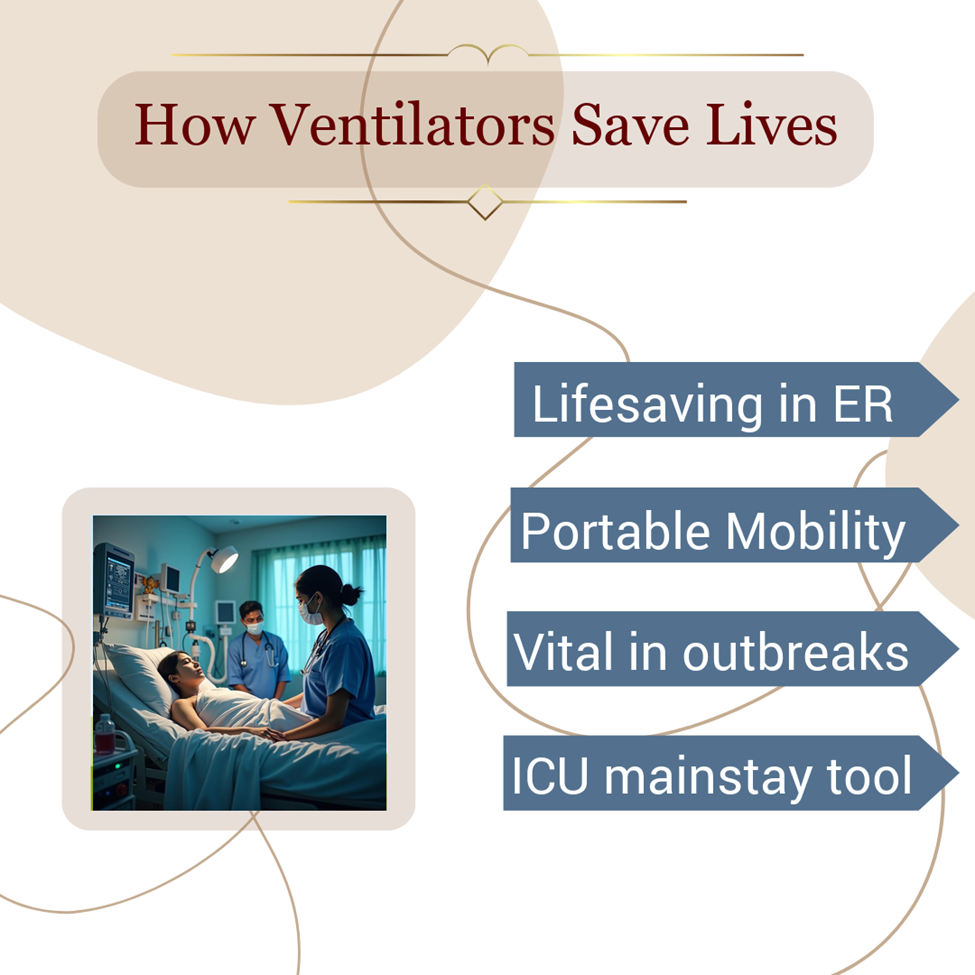
Ventilators have been present in hospitals for decades and have proven their worth time and again. From treating premature babies with underdeveloped lungs to aiding adults with severe asthma attacks, they have become a mainstay in modern medicine.
The evolution of ventilators over the years is incredible too. Initially, they were massive machines stationed in hospital wards. Today, innovations have allowed for the development of portable ventilators that are easier to transport and manage in various healthcare contexts. The question “how does a portable ventilator work” may arise. These versions operate on similar principles but are designed for flexibility and mobility.
Real stories bring to life the critical role ventilators play. Consider disease outbreaks like the SARS epidemic in 2003 or the recent COVID-19 pandemic. During such emergencies, ventilators were vital in saving numerous lives by providing temporary respiratory support to those in critical conditions. Today, most hospital ICUs use ventilators to give patients a better fighting chance.
Understanding the working principle of medical ventilators explains why these machines are indispensable in many medical situations. With their ability to sustain life by supporting or taking over the work of the lungs, ventilators are a testament to human ingenuity in healthcare.
2. Decoding Components of a Medical Ventilator
Every ventilator can be broken down into several key parts that work in harmony: – Airflow valves: These control the air’s pressure and volume entering the patients’ lungs. Precision is vital here because too much or too little air can be harmful. – Filters: Protect both the machine and the patient. They remove contaminants from the air, ensuring the air is clean. – Breathing tubes: Connect the machine to the patient. These tubes must remain clean and clear. – Monitors: Essential for both safety and effectiveness. These display vital statistics like breathing rate and oxygen levels, which guide healthcare providers in making adjustments.
Understanding these parts helps to demystify how medical ventilators function in hospitals. These components work together to deliver steady airflow, mimicking the rhythm of natural breaths. This orchestration is crucial as it ensures that patients receive the essential oxygen while carbon dioxide is effectively removed.
Modern ventilators even integrate advanced monitors that provide real-time feedback about the patient’s respiratory status. Such feedback is critical not only for immediate patient care but also for ensuring smooth ventilator operations.
3. Understanding the Working Mechanism
Every ventilator follows a sequence to help patients breathe efficiently. Here’s a simplified explanation:
- Initiate Breathing: The ventilator starts by pushing air into the patient’s lungs through the breathing tubes.
- Inflation: Air enters, inflating the lungs, mimicking the action when we naturally inhale.
- Hold and Release: After inflation, the machine holds the air momentarily before allowing it to escape, akin to exhaling.
- Exhalation: The machine then allows carbon dioxide to leave the lungs and reset for the next breath cycle.
This entire cycle can be customized according to the needs of the patient using different modes. There’s a mechanical ventilation process for every situation. For some patients, a volume-control mode regulating the amount of air delivered per breath is necessary. Others may require a pressure-support mode that adjusts pressure during each breath cycle.
In ICUs, ventilators are carefully monitored. This allows healthcare workers to make needed adjustments to ensure optimal outcomes. The ventilator operations explained here underscore their complexity and precision.
4. Common Myths and Misconceptions Debunked
One common misconception is that ventilator use leads to permanent dependency. However, in most scenarios, ventilators are meant for temporary support. The goal in intensive care often includes a ventilator weaning process, gradually reducing reliance on the machine. Understanding the process of weaning the patient off the ventilator can put minds at ease. This involves gradually decreasing the support as the patient’s lungs recover.
Another myth is about long-term harmful effects. While there can be risks with prolonged use, patients usually experience significantly more benefits than detriments. Medical teams continuously evaluate and adapt treatment plans to minimize potential drawbacks.
Weaning off a ventilator also involves assessing a patient’s ability to breathe independently. It’s a careful procedure ensuring patients aren’t hastened through the transition.
Evidence-based research helps dispel these myths and supports informed decision-making. Such clarifications break the stigma surrounding medical ventilators, paving the way for open dialogues about their life-saving potential.
5. Charting the Future of Ventilator Technology
The future of ventilator technology is full of promise, thanks to significant advancements in the field. One exciting development is the integration of Artificial Intelligence (AI). With AI, mechanical ventilation processes become smarter and more adaptive to patient needs. By analyzing real-time health data, AI can customize ventilator settings to better cater to each patient’s specific requirements. Imagine having a solution that fits each person perfectly like a tailor-made suit, not just a generic option. This technological stride could greatly reduce complications during the ventilator weaning process.
Implementing new tech in India’s healthcare system has its hurdles. High costs can be a concern since these advanced machines come with hefty price tags. Training medical staff to operate these new systems effectively is crucial, yet not all hospitals may have these resources. That said, the potential benefits are immense. Improved ventilators could enhance care quality and lessen dependency on long-term mechanical support. They might even present cost-friendly options for rural medical centers. As understanding medical ventilators deepens, patient care may undergo positive change, offering hope for the future.
